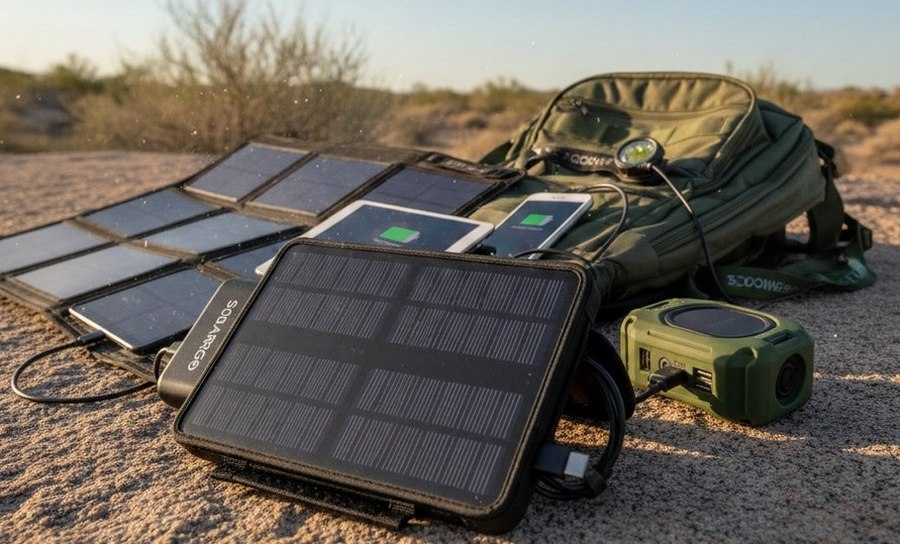
portable solar chargers are quickly becoming must-have tools for anyone who needs dependable power while traveling, camping, backpacking, or preparing for emergencies. As our reliance on phones, navigation devices, and portable electronics increases, having a reliable off-grid charging solution is no longer optional—it’s essential.
Not all solar chargers perform the same in real-world conditions. While many products advertise impressive wattage numbers, actual output depends on sunlight, panel efficiency, and charging stability. Choosing the right model means understanding how it performs outside of perfect laboratory settings.
Your intended use plays a major role in selecting the best option. Backpackers often need lightweight, foldable designs that won’t slow them down, while campers and overlanders may prioritize higher power output to charge batteries or power stations. Everyday travelers may look for versatility and wide device compatibility.
Durability is just as important as performance. A quality solar charger should withstand dust, splashes, heat, and regular outdoor handling. Weather resistance and solid construction ensure your charger keeps working when conditions are less than ideal.
Charging safety and efficiency should never be overlooked. Built-in regulators, stable voltage output, and compatibility with power banks help protect your devices and improve overall charging reliability, especially when sunlight is inconsistent.
Understanding these key factors makes all the difference. With realistic expectations and the right features in mind, choosing the best portable solar charger becomes much easier—ensuring you stay powered, connected, and prepared wherever your journey takes you.
The Best Portable Solar Chargers of 2026
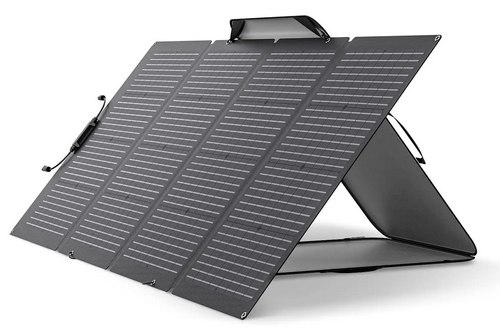
EcoFlow 220W Bifacial Portable Solar Panel
Pros
- Captures sunlight on both sides of the panel
- Tempered glass is thin and durable
- Good price for its size and power
- Panel and carrying case are both waterproof
Cons
- Expensive
- Heavy
- Limited use cases
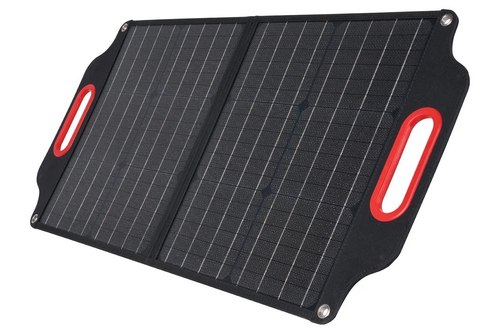
Outdoor Tech Dawn Solar Panel
Pros
- Plenty powerful for the money
- Magnetically clasping handles makes carrying easy
- Built-in pouch holds charging cords
- Integrated DC and USB-C cables
- Digital readout provides instant info
Cons
- IPX3 leaves it susceptible to dust and rain
- Not able to charge bigger laptops directly
Xplorer Globetrotter 42:
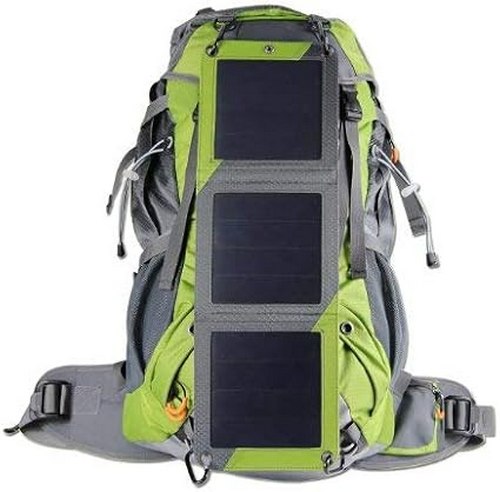
Pros
- Panel is thin and light
- Good power for its size
- Bundle includes several handy accessories
Cons
- Difficult to position
- Panel doesn’t feature a carrying pouch
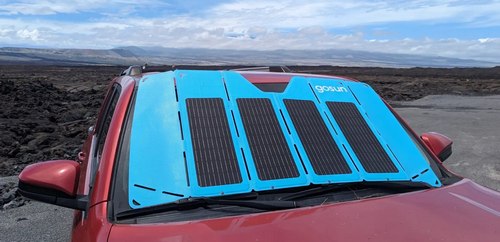
GoSun Shield
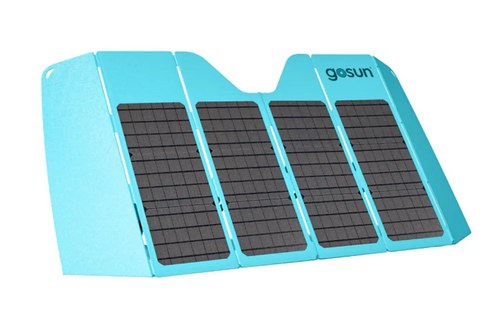
Pros
- Provides shade for car interior
- Able to jumpstart a car
- Can be used away from vehicle
- Multiple charging ports
Cons
- Weak power for its size
- Doesn’t fit in a backpack
Pale Blue Earth Approach Portable Solar Panels
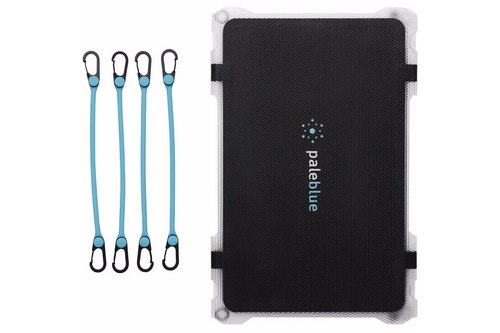
Pros
- Simple and super lightweight
- Dual USB charging ports
- Built-in cargo storage pouch
- Includes lashing cords
Cons
- Only powers small devices
- Not weatherproof
- Relatively weak for its price
GoalZero Nomad 20
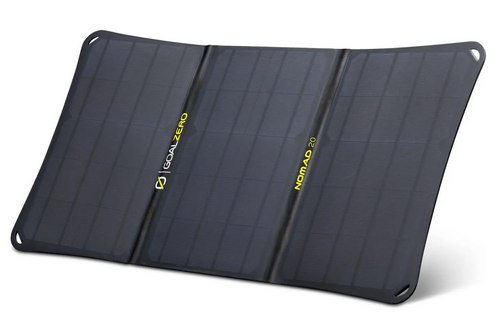
Pros
- Decent power for its size
- Adjustable stand
- Integrated DC cable
- Flexible charging port
- Works great with external battery
Cons
- Not the strongest value for the price
- No carrying case
BLAVOR Solar Power Bank 10,000mAh
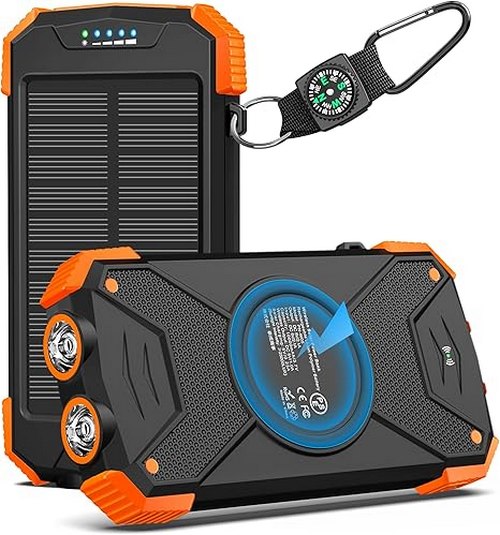
Pros
-
-
Over 10 years in solar power banks gives BLAVOR solid credibility
-
Widely used and trusted by millions of users globally
2. Fast & modern charging options
-
USB-C 20W fast charging (strong for a solar power bank)
-
Wireless charging support
-
Can charge up to 3 devices at the same time
-
Broad compatibility (iPhone, iPad, Samsung, etc.)
3. High-quality battery
-
Uses Lithium-cobalt battery, which offers longer cycle life than standard Li-polymer
-
Real-rated 10,000mAh (not inflated capacity claims)
-
Efficient charging performance for phones and tablets
4. Compact & lightweight
-
One of the smallest and lightest solar chargers in its capacity range
-
Easy to carry for hiking, camping, and travel
5. Durable & outdoor-ready design
-
Flame-retardant ABS + PC materials
-
Waterproof silicone protection
-
IPX5 water resistance, dustproof, and shockproof
-
Comfortable rubberized grip and premium feel
6. Useful outdoor extras
-
Dual super-bright LED flashlights
-
Compass carabiner for emergencies
-
Ideal for camping, hiking, power outages, and trave
-
Cons
-
Solar panels are mainly for emergency backup, not full recharging
-
Not practical as a primary charging method
MPowerd Luci + Powerbank
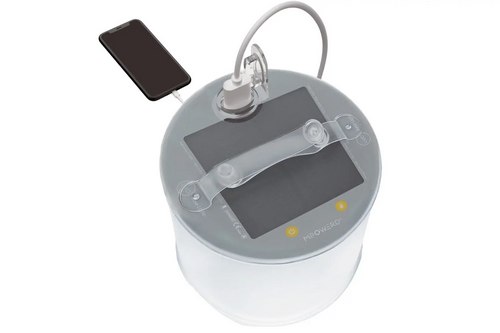
Pros
- Compact and lightweight
- Decorative and fun
- Up to 50 hours of light
- Waterproof
- USB-A and USB-C charging ports
Cons
- Small solar panel
- Have to inflate to fully use
- Only white light
Best Portable Solar Charger Comparison Chart
| Portable Solar Charger | Max Power Output | Weight | Weatherproof | Adjustable Stand | Carrying | Charging Ports | Dimensions | Best For |
|---|---|---|---|---|---|---|---|---|
| EcoFlow 220W Bifacial Portable Solar Panel | 220W | 20.9 lbs. | IP68 | Yes | Waterproof case | Integrated DC cables x 2 | 23 x 24.3 x 1.5 in. folded, 72.0 x 32.3 x 1.0 in. unfolded | Overlanding, RVing, charging portable power stations |
| Outdoor Tech Dawn Solar Panel | 40W | 4.85 lbs. | IPX3 | Yes | Built-in handles, pouch | USB-A, integrated cables for USB-C and DC x 2 | USB-A, integrated cables for USB-C and DC x 2 | Car camping, glamping, general use |
| GoSun Solar Panel Backpack | 10W | 0.65 lbs. | N/A | No | Inside backpack | USB-A | 5.25 x 7 in. folded; 10.5 x 7 in. unfolded | Hiking, backpacking |
| GoSun Shield | 60W | 9 lbs. | N/A | Yes | Strap holds together when folded | USB-C, USB-A, DC | 9.5 x 27 in. folded, 56 x 27 in. unfolded | Overlanding, car camping |
| Pale Blue Earth Approach Portable Solar Panels | 7W | 0.68 lbs. | IP53 | No | No case | USB-A x 2 | 7.9 x 11.8 x 0.8 in. | Through-hiking, charging phones and cameras |
| GoalZero Nomad 20 | 20W | 2.28 lbs. | IP65 | Yes | No case | DC, USB-A | 11.5 x 7.4 x 1.3 in. folded, 11.5 x 21.8 x 0.8 in. unfolded | Travel, camping, charging power banks |
| BoomPods Neutron Power Bank | N/A | 0.83 lbs. | IPX4 | No | No case | USB-A x 2 | 3.3 x 6.7 x 0.9 in. | Charging phones and other small devices |
| MPowerd Luci + Powerbank | N/A | 0.63 lbs. | IP67 | No | Strap | USB-C, USB-A | 6 x 1.5 in. collapsed; 6 x 5.4 in. Inflated | Camping, charging phones and other small devices |
How We Tested the Best Portable Solar Chargers
Our philosophy at GearJunkie is simple: embrace the gear that gets us outside. In the world of gadgets, that translates into many devices that inevitably require power. So, when it comes to solar technology, we like to keep current.
Our Expert Tester
Leading our testing efforts, Scott Tharler has been writing about consumer electronics for various outlets for over 25 years. Throughout that time, Tharler has attended CES more than two dozen times. Covering power-related products is one of his favorite beats. He met the GoSun guys right when they launched their first solar oven. And first-hand, he’s witnessed wire-free charging tech that promises to power small devices through the air.
Over that same span, it’s become commonplace to see solar technology helping to illuminate our walkways, tech up our campsites, and lower our electric bills. We’re all about it. And we’ll continue to cull and assess additional portable solar chargers for future iterations of this guide.
Looking for more tech? Check out our roundups of the best portable power stations and the best power banks.
Our Testing Process
Throughout several weeks of testing in typical real-world situations, we used a wide variety of portable solar chargers. Some were small novelties, including a power bank and a few lanterns, each clad with solar cells capable of topping off our phones.
Others were varying sizes of dedicated solar panels, with the larger folding variety able to refill an entire portable power station, one of which we also tested specifically for this guide. All that to say, it’s been months since we’ve seen a wall outlet…and our phones haven’t died once.
We conducted our research on the Big Island of Hawaii, no stranger to sunshine. But we also tested on cloudy days and even left the panels out in the occasional rainstorm once or twice. In the end, we rated these products based on such factors as power (relative to price and panel area), ease of use, portability, adjustability, price, and special features.
Buyer’s Guide: How to Choose a Portable Solar Charger
Creating Series
Is it better to get more solar panels of a lower wattage or fewer at a higher wattage? The answer to this question depends on whether you more heavily value price or modularity. In other words, it might be less expensive — not to mention easier to transport and simpler to use — a 400W solar panel as opposed to four 100W panels. But if you usually only need a 100W panel to refill your portable power station of choice, there’s no sense lugging around a 400W beast every time.
If you decide that you do want to connect a series of solar panels, it’s easiest/best to go with the same brand, model, and wattage. That way, you can just follow the suggestions on the site about how many can be connected in a series and have peace of mind that they’ll play nicely together.
Portable Power Stations
Having said what we just did about connecting panels in series, it’s possible to mix and match solar panels from one brand with portable power stations from another. Conversely, manufacturers sometimes change their connection port types, rendering previous solar panels incompatible with newer power stations.
In either case, don’t assume that a solar panel will connect to a portable power station — with or without an adapter. Look to see what type of connection it’s sporting. For instance, MC4 is a popular kind of DC connection you might encounter. But especially if you’re purchasing a solar panel and portable power station separately, first be sure to check the physical shape and electrical compatibility of their connection.
Price & Value
For what it’s worth, the average price of all the portable solar chargers we tested was around $170. But that varies wildly, along with the power and size of the chargers. To level the playing field, we calculated the price per watt. So, although the retail cost of purchasing the GoSun Shield, Outdoor Tech Dawn, and EcoFlow 220W Bifacial ranged broadly from $130 to $649, each of those costs roughly $3 per watt, but each of these comes with a few different features depending on how much you want to spend. Here’s what you get for your money.
Budget
There are plenty of portable solar power banks for under $100, but these are geared more toward powering smaller devices, and the quality can vary wildly. If you just want to keep your cell phone going during an off-grid trip, we’d recommend something like the BoomPods Neutron Power Bank ($55). Roughly the size of a cell phone, this power bank can charge two USB-powered devices at once, packs a built-in flashlight, and has a solar panel on one side that can keep it powered.
Mid-Tier
If you need a bit more juice, you can find more substantial solar charges in the $100 to $200 range. The Outdoor Tech Dawn Solar Panel ($130) can pump out 40 watts of power It is easy to carry thanks to its integrated handles and magnetic clasps, and its built-in pouch carries an integrated USB-C cord, two DC cords, and a standard USB-A port as well.
Premium
As with most tech-y gear, the sky’s the limit when it comes to price. Our top pick, the EcoFlow 220W Bifacial Portable Solar Panel ($649) is the biggest and most powerful solar charger on our list, with a whopping 220-watt power output. It also has solar cells on both sides of the solar panel, which means that, in addition to getting power directly from the sun, the panel can also absorb reflected sunlight from the ground.
Frequently Asked Questions
Will a solar panel actually generate the power it’s rated for?
In most real-world situations, no. The wattage listed on a solar panel represents its maximum output under ideal laboratory conditions, not everyday use. In practical outdoor scenarios—even in direct sunlight—you can usually expect a panel to deliver around 25% to 75% of its rated power.
Several external factors influence performance, including your geographic location, season, time of day, cloud cover, shade, dirt on the panel, and even ambient temperature. This is especially important to understand when using fast charging solar chargers or a lightweight solar charger for backpacking, where efficiency matters more than peak numbers. Simply put, ideal conditions are rare, so it’s best to set realistic expectations.
Can solar panels work on a cloudy day?
Yes, they can. Even on overcast days, sunlight still penetrates cloud cover, which allows solar panels to continue generating power—just at a reduced rate. This is why portable solar chargers for backpacking and best ultralight backpacking solar panel options are designed to capture diffuse light, not just direct sun.
Some solar panels can even collect a small amount of energy from indoor lighting, although the output is minimal. That said, for maximum efficiency, best portable solar waterproof chargers and other outdoor models still perform best on bright, sunny days.
How can I optimize my solar panel’s performance?
There are three key factors you can control:
-
Keep the panel clean – Dust, sand, or debris can significantly reduce output.
-
Avoid shade – Even partial shading can impact performance.
-
Adjust the tilt – Repositioning the panel as the sun moves can noticeably improve results.
While some apps calculate the perfect angle based on location and time, that approach isn’t very practical for portable solar chargers for backpacking. A simpler solution is using built-in alignment tools, like the analog sundials found on panels such as the EcoFlow 220W Bifacial or BioLite SolarPanel series—features commonly appreciated by users seeking the best ultralight backpacking solar charger.
Are solar panels weatherproof?
Yes, but the level of protection varies. Always check the Ingress Protection (IP) rating. The first digit indicates dust resistance—ratings like IP53 or IP68 mean solid protection, which is ideal for desert, mountain, or windy environments.
The second digit refers to water resistance. Panels rated IPX4 to IP65 can handle rain and splashes, making them suitable for most outdoor use. Models rated IP67 or IP68 are fully waterproof and can even survive temporary submersion. This durability is a major reason why best portable solar waterproof chargers are popular among hikers, campers, and long-term travelers.
Can I connect multiple solar panels in a series?
Yes. This is common with solar panels rated at 100W or higher, especially in use cases like overlanding, RV travel, glamping, or even portable solar chargers for EV cars, where scalable power is essential.
While it’s technically possible to combine different panels with matching voltage and current ratings, the safest and most efficient approach is to connect multiple units of the same model. This ensures consistent performance and reduces the risk of compatibility issues.
Can a solar panel damage my device?
Yes—if you connect your device directly to a solar panel without regulation. Understanding the difference between watts and volts is crucial. Most phones and small electronics can handle higher wattage but are sensitive to voltage increases (typically above 5V).
Too little wattage may fail to charge larger devices like laptops, while unstable voltage can damage batteries over time. That’s why many modern fast charging solar chargers include built-in charge controllers or internal batteries to regulate output safely.
An even safer option is to charge an external battery or portable power station first, then use that battery to charge your devices. For example, power banks like the GoalZero Sherpa 100AC—often featured in best portable solar chargers 2026 roundups—are designed to accept solar input and deliver stable, device-safe power.